
Buy the DJI Neo Fly More Combo, not the drone alone. Our review covers flight time, wind limits, storage, Irish registration and which Neo bundle to pick.
The DJI Neo is the easiest way to get a camera into the air, and the Fly More Combo is the version to buy. For a few euro more than the controller-free bundle, it adds DJI's RC-N3 remote, which turns the Neo from a party trick into a drone you can actually pilot.
The short verdict: brilliant for selfie video, travel and first-time flyers. Less good on exposed Irish coastline, where its light frame meets its limit quickly.
What the Neo is, and who should buy one
The Neo is DJI's smallest and simplest drone. It weighs 135g, lighter than most smartphones, and it is designed to fly itself as much as be flown.
You can launch it from your palm with a single button and catch it again as it lands. In between, it can follow you while you walk or cycle. Pre-set QuickShots fly cinematic moves around you automatically, so you get footage that would otherwise need a second person.
That makes it ideal for two kinds of buyer: the first-time pilot, and anyone who wants video of themselves without a camera operator, whether travelling or out on the bike. If you mainly want scenic photography, a DJI Mini with a three-axis gimbal will serve you better.
DJI Neo at a glance
| Weight | About 135g |
| Flight time | About 18 min per battery |
| Wind resistance | Up to 8 m/s (Level 4) |
| Video | 4K at 30fps |
| Sensor | 1/2-inch |
| Stabilisation | Single-axis gimbal plus EIS |
| Obstacle sensing | None |
| Phone-only range | About 50m over Wi-Fi |
Three ways to fly it
From your palm. Press the mode button, hold out your hand and the Neo lifts off into whichever automatic mode you picked. No phone or remote needed. It is clever, and it is how most owners use it day to day.
From your phone. The DJI Fly app connects over Wi-Fi and gives you virtual sticks on screen. It works, but range is only around 50 metres and touchscreen sticks are fiddly in a breeze.
With the RC-N3 remote. This is where the Neo becomes a proper drone. Physical sticks give precise control, and the link reaches far beyond the phone's 50 metres. If you plan to fly anywhere bigger than a back garden, you want the remote.
Camera and storage
The 1/2-inch sensor records 4K at 30 frames per second. In good light, footage is sharp and colourful. In the dull grey light of an Irish winter afternoon, expect softer detail and more noise than a larger-sensor drone would give you.
Stabilisation comes from a single-axis tilt gimbal, helped by electronic stabilisation. Straight flights look smooth. Fast turns and gusty conditions show more wobble than a three-axis Mini.
There is no microSD slot. Footage saves to internal storage, which you then transfer to your phone or computer. Clear it after every outing, or you will run out at exactly the wrong moment.
The two Neo combos compared
The drone on its own is rarely in stock in Ireland, and it comes with just one battery. That leaves two bundles worth considering, at almost the same price.
The Fly More Combo adds DJI's RC-N3 remote. The Three-Battery Combo leaves the remote out. Both include three batteries and a multi-battery charger.
With the price gap so small, the remote is effectively free. Unless you are certain you will only ever fly by palm and phone, buy the Fly More Combo.
DroneGuide.ie is reader-supported. When you buy through links on our site, we may earn an affiliate commission. As an Amazon Associate I earn from qualifying purchases. Learn more
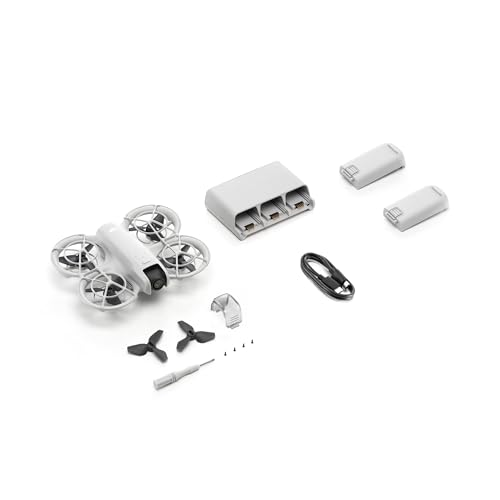
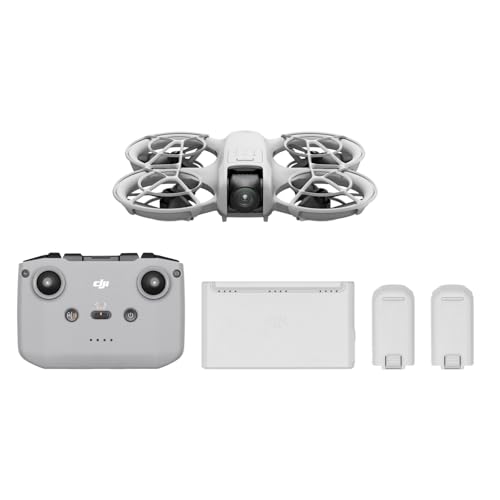
RC-N3 remote plus three batteries
The complete Neo. The remote adds range and precise control, and three batteries give you close to an hour in the air.
Where the Neo falls short
Wind. DJI's own specification rates the Neo for winds up to 8 metres per second. Met Éireann's records show average annual wind speeds above 8 metres per second in the far north of Ireland. On a typical day at Malin Head, the Neo is already working at its limit. Inland and on calm mornings, it flies happily.
No obstacle sensing. The Neo has downward sensors to help it hover, but nothing looking forward or to the sides. In follow mode it will fly into a branch if one gets in its way. Use automatic modes in open spaces only.
Short battery life. Around 18 minutes per battery sounds fine, but automatic modes and cold weather eat into it. Three batteries are the minimum for a proper session.
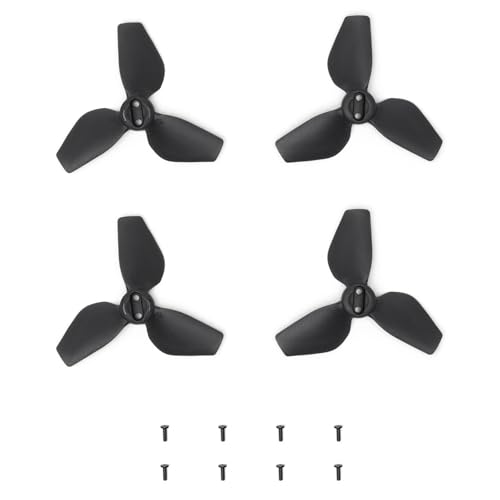
Props take a beating. Palm landings and the odd bump wear the propellers down. A spare set costs very little and is worth ordering with the drone. Our accessories guide covers the other extras worth having.
- Light and small enough for any pocket
- Palm launch and landing
- Follows you and films itself
- Fly More Combo is excellent value
- Struggles in strong coastal wind
- No obstacle sensing and no microSD slot
Easy to fly, genuinely portable and great fun. Buy the Fly More Combo for the remote, and pick a calm day for the coast.
Do you need to register a DJI Neo in Ireland?
Yes. The Neo weighs well under 250g, but it has a camera, and the IAA's registration rules apply to any drone with a camera. You register yourself once as an operator through MySRS, then put your operator number on the drone.
There is no pilot exam. The Neo carries a C0 class mark, which under the EASA open category rules lets you fly in the A1 subcategory. You still need to stay below 120 metres, keep it in sight and stay away from crowds.
If the Neo is a present for someone under 16, a parent registers instead and supervises. The IAA's guidance spells this out. Our drone rules guide covers the rest, and the gift registration page walks through the Christmas morning version.
Should you buy something else?
If you want smoother scenic footage and better wind handling, step up to a DJI Mini with a three-axis gimbal. Our DJI Neo vs DJI Mini comparison weighs up the extra cost.
If you are shopping for a younger child, a crash-proof indoor drone may suit better for a year or two. Our guide to drones for kids is sorted by age. For a wider look at first drones, see the best drones for beginners.
Can you fly the DJI Neo without a controller?
Yes. It launches from your palm and flies automatic modes without any controller, and the DJI Fly app gives you on-screen sticks over Wi-Fi. Range by phone is only about 50 metres, so the RC-N3 remote is worth having.
Does the DJI Neo take a memory card?
No. It has no microSD slot and saves footage to internal storage, which you transfer to your phone or computer.
How long does the DJI Neo battery last?
DJI quotes about 18 minutes per battery. Wind, cold and automatic modes all reduce that, which is why the three-battery bundles make sense.
Is the DJI Neo good in wind?
Only moderately. It is rated for winds up to 8 metres per second, so it is best on calmer days and inland spots rather than exposed headlands.